

There is a version of Santorini that belongs to everyone – the postcard caldera, the blue domes and the cruise ships disgorging thousands of people each morning onto the same narrow lanes.
I’ve previously been among the thousands experiencing Santorini this way. This time, I’m here to find the island that lives quietly beneath it, patient and unhurried, waiting for those willing to step off the well-worn path. What I found exceeded every expectation I had dared to hold.
My home for these extraordinary days was the Andronis Boutique Hotel, perched on the caldera cliffs below Oia, yet with a quietness and seclusion that sets it apart from the surrounding town. The rooms are carved into volcanic rock in the style of traditional cave houses, with whitewashed curves, arched ceilings and architecture that feels grown rather than built.
The island is waiting, and it rewards those who move beyond the famous towns.
From my terrace each morning, the Aegean lies silvered in the early light, the cliffs dropping silently to the water far below. The infinity pool hangs above the caldera like a mirror held up to the sky. The staff have the gift of anticipating what you need slightly before you need it, while creating the impression that nothing could possibly be an imposition.
Breakfasts are events in themselves. Local cheeses, Santorinian honey, freshly baked bread and eggs collected nearby were served on the terrace as the morning light shifted from silver to gold. It would be easy to linger there for several hours without noticing the time pass. But the island is waiting, and it rewards those who move beyond the famous towns.
Village life
The real island reveals itself in its villages. Not the famous ones, but the quieter settlements scattered across the plateau and the eastern coast, where life continues at a pace fundamentally unchanged for generations.
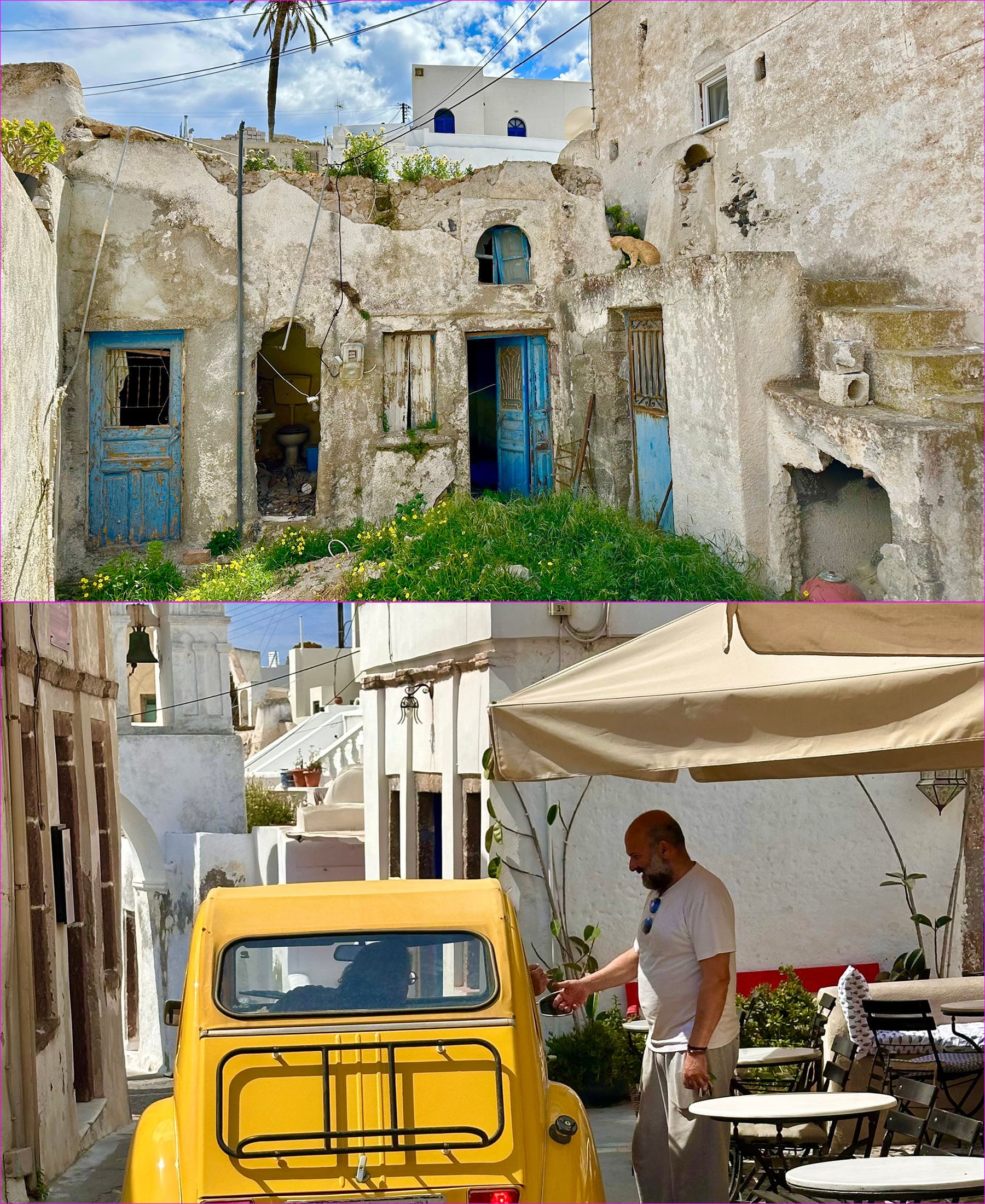
Climbing toward the island’s highest peak, I reach Pyrgos, the medieval former capital of Santorini. It is everything Oia once was before the world arrived. Venetian towers rise from whitewashed lanes and Byzantine churches outnumber cafes.
From the ruined kasteli at its crown, there is a 360-degree panorama of the entire island. At sunset, while crowds jostled for position in Oia, Pyrgos belonged almost entirely to me.
In Emporio, the largest of the ancient villages, I walk labyrinthine lanes deliberately designed to disorient invaders. I step through an archway where a single taverna and a sleeping cat constitute the afternoon’s entertainment.
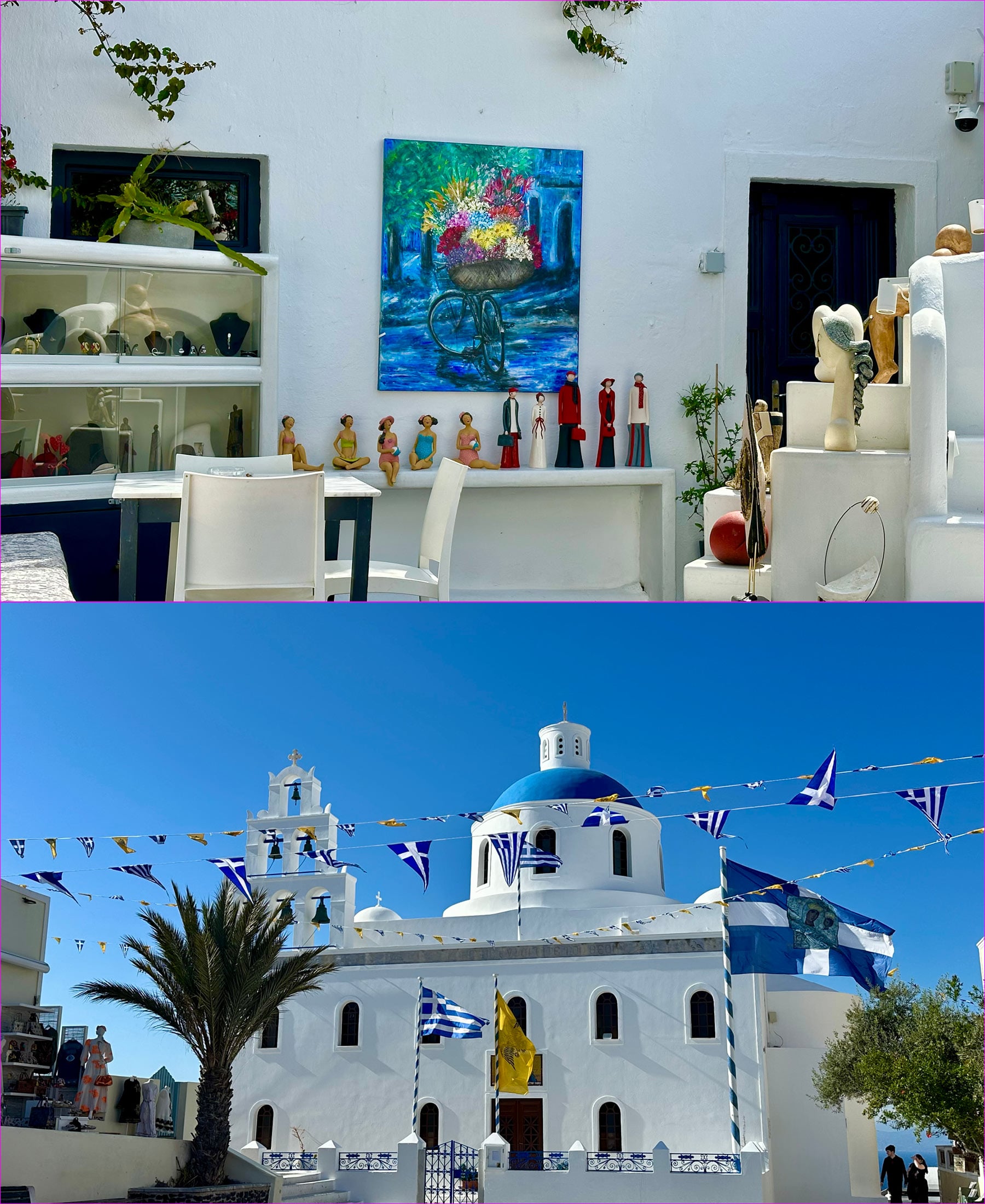
Then there is Megalochori, beloved by those who know it. Its main square, lined with neoclassical sea captains’ mansions and a campanile that chimes the hours, is a place where locals actually live, rather than a stage set for visitors.
At sunset, while crowds jostled for position in Oia, Pyrgos belonged almost entirely to me.
Down on the southern coast, the world changes entirely. Vlychada’s harbor is a working one – fishing boats, salty air and the rhythms of actual maritime life. The nearby beach unfurls beneath pumice cliffs sculpted by millennia of wind into something that belongs more to a lunar landscape than a Greek island. It is strange, arresting and largely free of crowds, even during peak season.
The Red Beach, meanwhile, is a geological drama. Cliffs of deep crimson volcanic rock plunge toward a shore of red and black pebbles, the Aegean impossibly blue against them. It is, genuinely, one of the most beautiful things I have ever seen.
Akrotiri pulled me into an entirely different dimension – a time capsule. This Minoan city, buried by volcanic ash 3,600 years ago, was uncovered in 1967. It is preserved beneath a climate-controlled shelter where visitors can walk the actual streets of a Bronze Age civilization.
Three-story buildings. Running water. Elaborate drainage. Frescoes of breathtaking beauty. This was one of the most sophisticated cities in the ancient world, and it was buried in the middle of an ordinary morning. Storage jars remain in storerooms and furniture impressions are still preserved in the ash.
That this catastrophic eruption may have given rise to the legend of Atlantis only adds to the charge of standing there.
Island flavors
Then came the wine, and the island revealed another layer. High above the port of Athinios, where the caldera cliffs plunge most steeply, sits Venetsanos 1947 Assyrtiko Winery.
One of Greece’s oldest wine estates, it was founded by the visionary George Venetsanos and is now tended by his grandnephews, Anastasios-Nikolaos and Vaggelis Zorzos. The two men welcome me with the warmth of people who have something extraordinary to share and know it. They pour, talk and gesture toward the caldera below as though the landscape itself were part of the explanation. And it is.
Assyrtiko is one of the most paradoxical wines on Earth. Tasted blind, its minerality and racy acidity suggest Burgundy rather than a sun-scorched Aegean island. That it grows here is one of the great mysteries of wine.
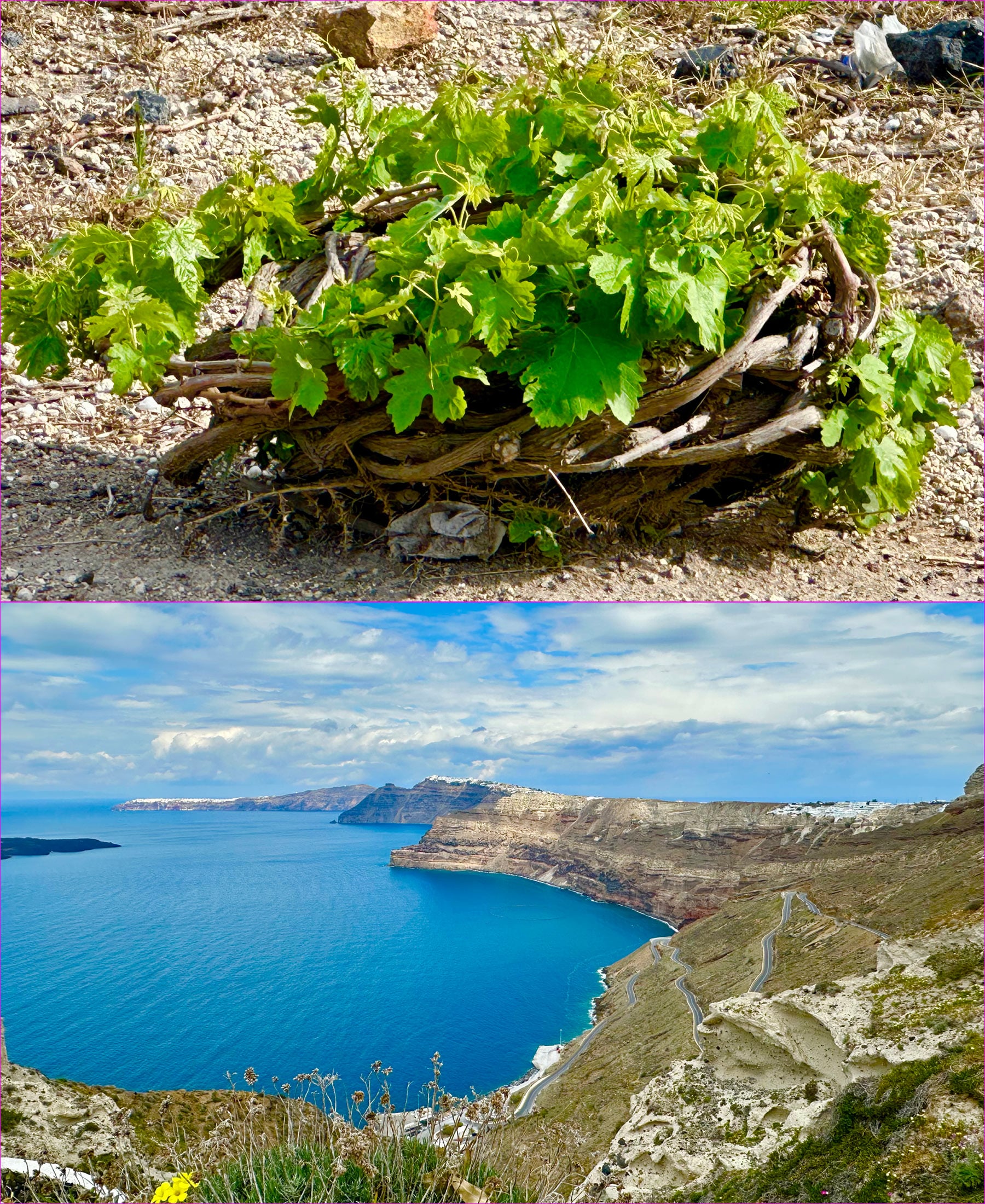
The secret lies in an extraordinary combination of volcanic terroir, near-zero rainfall and the Meltemi winds that batter the island each summer. These conditions force the ancient vines, many of them centuries old, into a training method unique to Santorini called kouloura. Each vine is trained low into a basket shape, hugging the ground and sheltering the fruit. The yields are tiny. The concentration is extraordinary.
Nothing prepares you for Santorinian food.
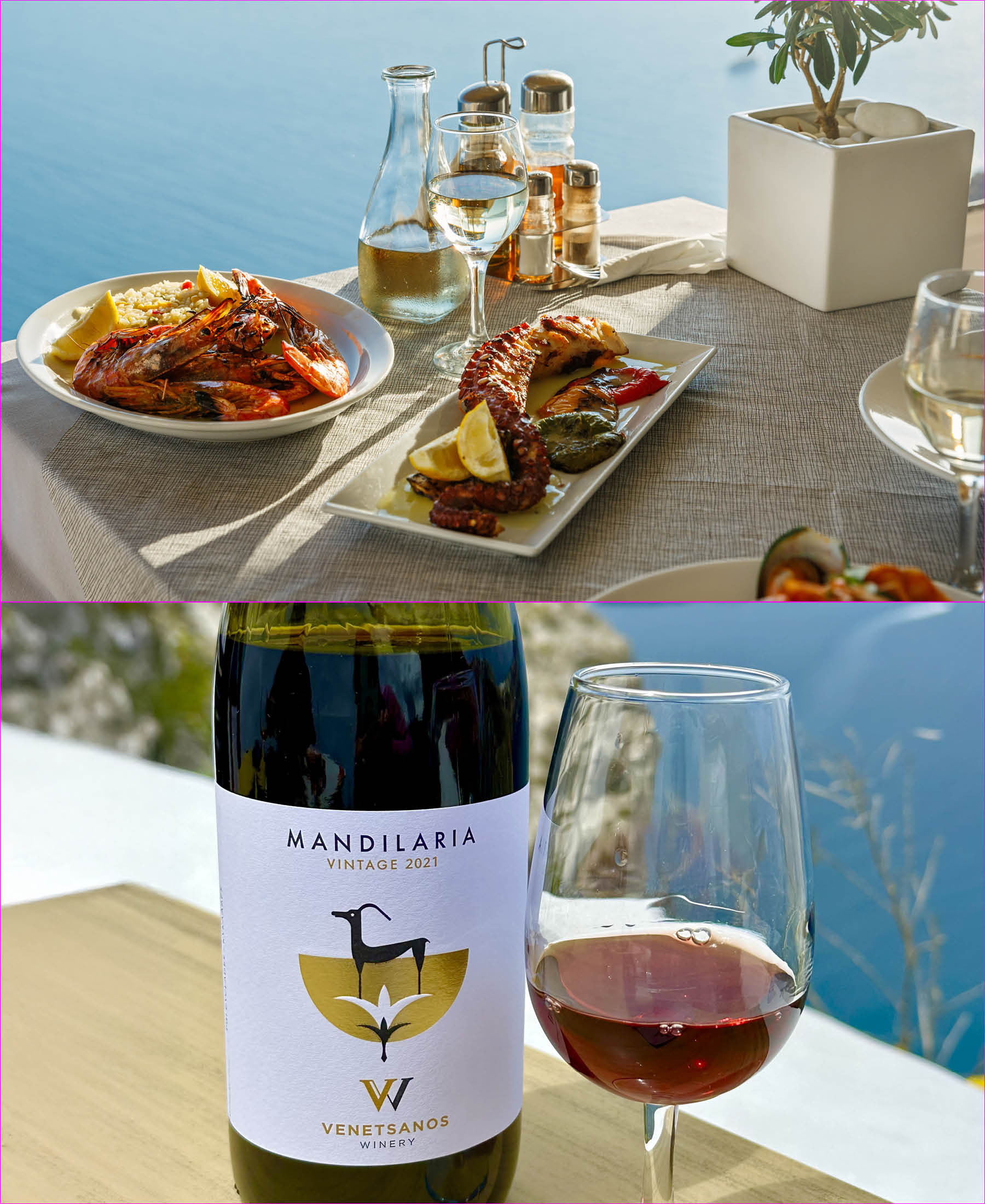
Anastasios-Nikolaos pours not just Assyrtiko, but Athiri, Aidani, Platani, the remarkable red Mavrotragano and Mandilaria. He introduces them as though they are old friends, sharing not only tasting notes but the generations of people behind every bottle.
Each wine arrives paired with Santorini’s finest fava, crispy tomato fritters, Cycladic cheeses, Greek cold cuts and rich tomato paste. Behind it all, the caldera drops away to the sea far below. I don’t want the afternoon to end. It remains one of my best experiences on the island.
Nothing prepares you for Santorinian food. This is not Greek cuisine adapted for tourists. It is a tradition shaped by centuries of scarcity and ingenuity on an island with almost no fresh water and soil that forces every flavor into fierce concentration.
Fava, a silky golden puree made from yellow split peas which have grown on the island for centuries, tastes unlike anything you have had before. Earthy and nutty, it is finished with capers, raw onion and olive oil.
The tomatokeftedes are crispy fried fritters bursting with tomato intensity. They are made from cherry tomatoes so concentrated by volcanic soil and drought that they seem to contain an entire summer in each one.
Into the caldera
The caldera itself demands to be explored, not just admired from above. A boat to Nea Kameni, the active volcanic island at the caldera’s heart, brings you onto raw lava fields that still steam gently from the Earth’s interior. A walk to the summit crater helps you understand, viscerally, the force that created this island.
The boat then continues to the hot springs of Palea Kameni, where you swim through increasingly warm water toward a rust-colored thermal spring.
The return to Ammoudi Bay, where seafood restaurants cling to the water’s edge at the base of Oia’s cliffs, completes a day that moves from ancient sea to active volcano to timeless table.
A walk to the summit crater helps you understand, viscerally, the force that created this island.
Santorini is a place so loved by so many that it has learned to hide its finest self from those who do not look closely. It hides in the lanes of Pyrgos that lead to an unlocked Byzantine chapel and in the caper plant growing from a wall that no-one photographs.
It is found in an ancient kouloura vine above Megalochori, its basket shape unchanged for 200 years. And in the easy, generous conversation that begins when you find the right table in the right village, order a carafe of wine and ask what they recommend today.
That Santorini – unhurried and more beautiful than it has any right to be – is the one I carry home. And it’s the one I know will draw me back.


